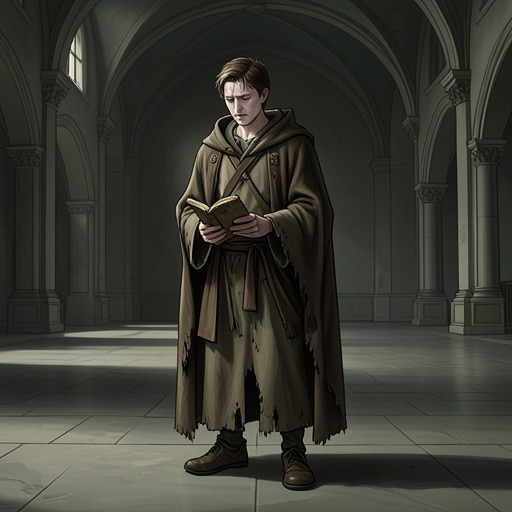
Conrad's death beneath the giant helmet
The Castle of OtrantoConrad's death beneath the giant helmet is the sudden catastrophe that breaks up his wedding ceremony and turns a dynastic dispute into an immediate supernatural crisis. The enormous helmet kills Manfred’s only son on the very day set for his marriage to Isabella; its appearance also anticipates the prophecy that Otranto will pass from the ruling family when its rightful owner grows too large to inhabit the castle.
The interrupted wedding
Conrad’s birthday had been chosen for his marriage to Isabella, and the company had gathered in the castle chapel for the ceremony. Manfred had hurried toward the match despite his son’s youth and infirmities, a decision that his wife, Hippolita, had privately questioned. The wedding was also bound up with Manfred’s anxiety about the old prophecy that the castle and lordship would leave his family when the rightful owner became too large to live within it.
When Conrad was missing, Manfred sent a servant to summon him. The servant returned in a state of alarm, pointing toward the courtyard and finally crying, “Oh! the helmet! the helmet!” The wedding party’s expectation of a dynastic celebration gave way to confusion and fear before anyone could explain what had happened.
The discovery in the courtyard
Manfred went out to investigate. There he saw servants trying to raise what looked like a mountain of black plumes. The object was an enormous helmet, a hundred times larger than any human helmet and crowned with a proportionate mass of black feathers. Beneath it lay Conrad, killed by the impact.
The scene’s horror is sharpened by the disproportion between the intended ceremony and the impossible object that replaces it. The helmet is not merely a weapon or an accident: its scale makes it a portent, while the unexplained manner of its arrival leaves the assembled company unable to account for the death. The human cost is immediate, but the apparition’s meaning remains unresolved.
Manfred’s response and the succession crisis
Manfred’s reaction is strikingly divided. Though he has lost the son for whom he had shown particular fondness, he remains fixed on the helmet, examining it and seeming absorbed by the phenomenon rather than directing attention to the family’s grief. The corpse is carried into the hall without his instructions. His first recorded concern is for Isabella, whom he orders the household to care for; she is taken to her chamber, shaken by the events and grieving Conrad’s death.
The death also exposes the fragility of Manfred’s political plans. Conrad was his only heir, and the marriage was intended to secure the succession through Isabella. Instead, the catastrophe removes the prospective heir before the marriage can take place. Later, when a herald speaks for Frederic, he calls Manfred a usurper and demands both Isabella and the principality on behalf of Frederic, the nearest blood relative to Alfonso the Good. Manfred answers that his family’s claim rests on descent from Don Ricardo and on a supposed bequest by Alfonso, who had died childless in the Holy Land. The rival claims make Conrad’s death the opening disaster in a conflict over whether Otranto belongs to possession and asserted inheritance or to the rightful line.
Prophecy and retrospective meaning
The helmet’s appearance recalls the prophecy that Otranto would pass from its present family when its rightful owner had grown too large to inhabit the castle. At first, the connection between that prediction and Manfred’s hurried wedding had seemed obscure. Conrad’s death does not by itself resolve the prophecy, but it makes the castle’s political future inseparable from supernatural signs.
Near the end of the story, Manfred confesses that Alfonso died by poison and that Ricardo used a fictitious will to claim the inheritance. He recounts a prophecy received by Ricardo from Saint Nicholas: Ricardo’s descendants would rule Otranto until its rightful owner became too large to live in the castle, so long as Ricardo’s male line continued. Manfred connects the judgments that have overtaken his family with its usurpation, naming the loss of Conrad among the calamities for which he believes he is paying. Conrad’s death thus changes from an unexplained catastrophe into part of a larger reckoning over the legitimacy of Otranto’s rulers.